11-Day Tibet In-depth Tour
This 11-day Tibetan journey immerses travelers in the heart of the Himalayas, blending spirituality, culture, and awe-inspiring landscapes. From acclimatizing in sacred Lhasa to marveling at turquoise Yamdrok Lake and the majestic Everest Base Camp, the itinerary weaves through ancient monasteries like Jokhang Temple and Potala Palace. Experience serene retreats in Nyingchi’s pine forests, mystical glaciers, and vibrant Barkhor Street. Highlights include sunrise over Namtso Lake, the sacred rituals of Sera Monastery, and encounters with Tibetan hospitality. Designed for adventure and reflection, this tour balances high-altitude thrills with cultural depth.
Book this Tour
10 Nights (4+ star Hotel)
Included with every escorted tour
Day 1: Lhasa Arrival
Lhasa Arrival
4+stars Hotel
Dinner
Today, you will arrive at Lhasa, the holy city of the snowy plateau, at an elevation of 3,650 meters. A white hada (traditional Tibetan scarf) will be presented to you as a warm
welcome. Your driver will meet you at the airport and take you to your hotel for check-in.
Our best advice for you is to avoid excessive movement, refrain from bathing, drink plenty of water, and eat only until you are 80% full to prevent sudden altitude sickness.
Note
For first-time visitors to Tibet, today is especially crucial. With Lhasa’s elevation of 3,650 meters and only 65% of the oxygen available compared to inland areas,
it’s important to remain calm and follow some precautions. Drink plenty of water, eat fruits, and get enough rest to prevent altitude sickness. Avoid alcohol, smoking, and
overeating. It is also recommended not to take a bath that evening to prevent catching a cold.
Day 2: Lhasa - Nyingchi
Lhasa – Pagsum Lake – Nyingchi
4+stars Hotel
Breakfast – Lunch – Dinner
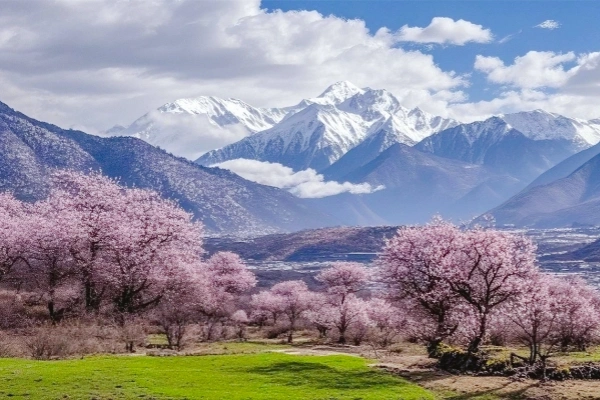
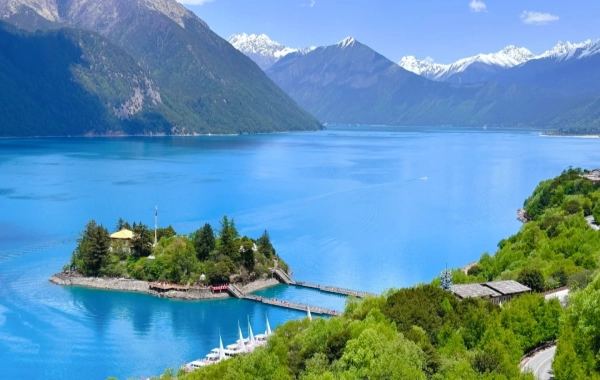
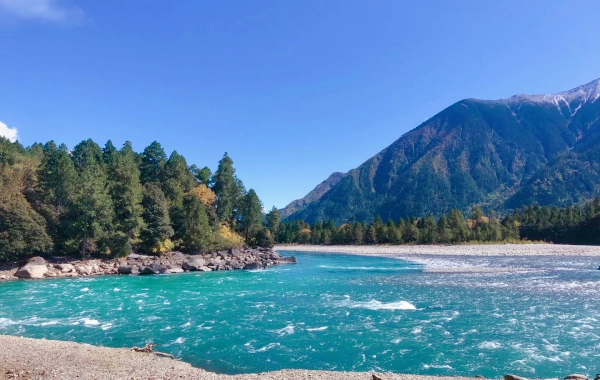
After breakfast, head to Pagsum Lake, the only AAAA-level scenic area in Tibet, a peaceful and forgotten paradise by time. Pagsum Lake, also known as Pagsum Co, has
crystal-clear waters, with surrounding snow-capped mountains reflecting on its surface. Sand gulls and white cranes float above the lake, while fish swim through the
transparent water, creating a serene atmosphere. In spring, the area around the lake is adorned with a riot of flowers, and the snow peaks are reflected in the water, making
the view exceptionally beautiful.
About 100 meters from the shore is a small island called Zaxi Island. According to legend, it is a “hollow island”—not connected to the lakebed but floating on the water.
On this island stands the Tang Dynasty temple, “Cuozong Gongba Monastery,” a renowned red sect temple in Tibet. Built in the late Tang Dynasty, it has a history of over
1,500 years. The temple is a two-story structure made of earth and wood, and inside it enshrines Padmasambhava (Lotus Guru), Thousand-Hand Guanyin, and the Golden
Boy and Jade Maiden. To the south of the temple is a unique tree, a “Peach and Pine Tree Couple,” where the peach blossoms and the evergreen pine form a beautiful
contrast in spring.
In the evening, head to the hotel for check-in
Day 3: Nyingchi
Nyingchi – King Cypress Tree – Yishe Manor – Sejila Mountain – Lu Lang Forest – Lu Lang International Tourism Town – Nyingchi
4+stars Hotel
Breakfast – Lunch – Dinner
After breakfast, visit the King Cypress Tree, where you can learn about the growth environment and ecological value of the cypress trees. It is estimated that this ancient
cypress tree is between 2,000 and 2,500 years old, and the locals protect it with great reverence, calling it the “Sacred Tree.”
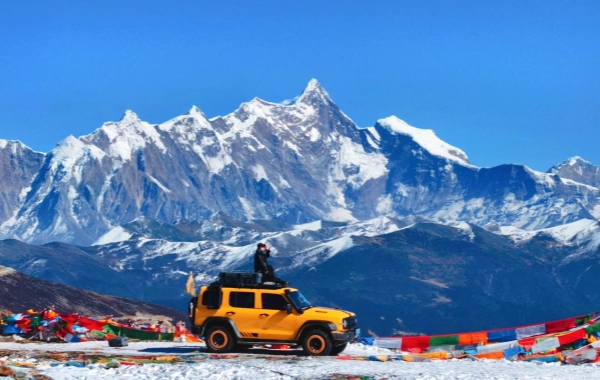
Next, head to Yishe Manor to enjoy the peacefulness and beauty of the manor. Then, continue to Sejila Mountain, which serves as a natural boundary between the eastern
and central-western parts of Nyingchi County. It is also the watershed between the Niyang River and the Parlung Zangbo River, and it is crossed by the southern route of
the Sichuan-Tibet Highway. From here, you can enjoy views of the sunrise, sea of clouds, the endless forest, and a distant view of the majestic Mount Namcha Barwa.
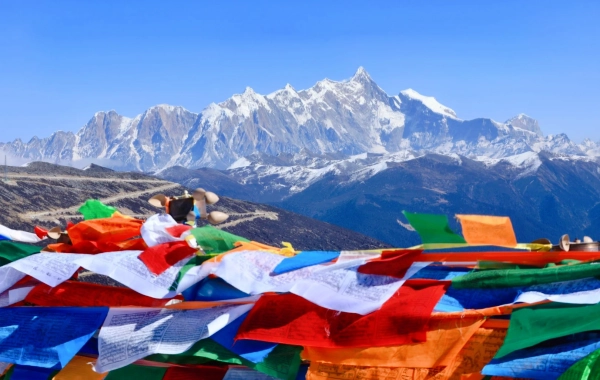
From afar, you can see Mount Namcha Barwa, located at the junction of the Himalayas, the Nyainqêntanglha Mountains, and the Hengduan Mountains. At 7,782 meters,
it is the highest peak in the Nyingchi region of Tibet and is part of the easternmost part of the Himalayas. Known as the “Father of All Mountains in Tibet,” it is also a sacred
site for the ancient Tibetan Bon religion.
Next, travel to Lu Lang Forest, one of China’s three major primeval forests, a place so beautiful you won’t want to leave. Located about 80 kilometers from Bayi Town in
Nyingchi, it is a narrow plateau mountain meadow with lush cypress and pine forests on both sides, gradually transitioning to dense woodland. In the center, you’ll find
vast, uniform meadows with winding streams and thousands of wildflowers blooming. Wooden fences, wooden houses, and pastoral villages dot the landscape, while
clouds gather and disperse in the mountain valleys. The combination of snow-capped mountains, forests, and meadows creates a tranquil and beautiful “mountain retreat”
scene.
Then, head to Rulang International Tourism Town to taste authentic Tibetan cuisine and experience the local charm of the town.
Day 4: Nyingchi - Lhasa
Nyingchi – Kadinggou – Ganden Monastery – Lhasa
4+stars Hotel
Breakfast – Lunch – Dinner
After breakfast, drive to Kadinggou, which in Tibetan means “Earthly Paradise.” The valley features towering mountains that reach into the clouds, creating a typical canyon
landscape. You’ll see unique rock formations, ancient trees, and a spectacular waterfall that cascades down nearly 200 meters, creating a magnificent sight. The cliffs naturally
form various sacred figures, such as a giant Buddha, a goddess, Guanyin, Dharma protectors, the Buddha, a Lama chanting scriptures, a divine turtle calling to the heavens,
a divine eagle offering treasures, a butter lamp, and the Tibetan “Six Syllable Mantra.” The fresh and natural air will make you feel completely enchanted by the natural oxygen
bar.
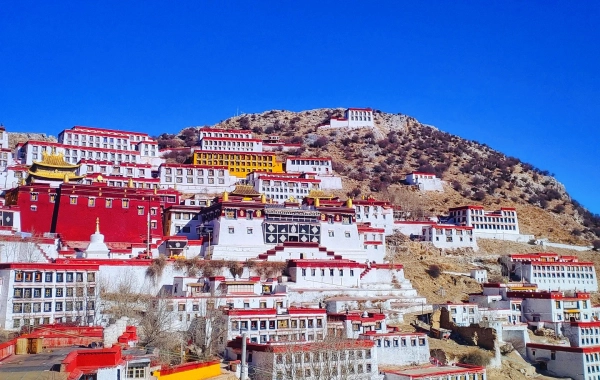
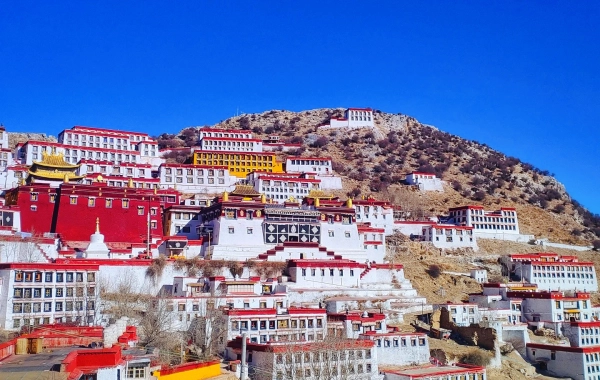
In the afternoon, arrive in Lhasa and visit Ganden Monastery, one of the “Three Great Monasteries of Lhasa,” along with Drepung Monastery and Sera Monastery. It is also
one of the six major monasteries of the Gelug school of Tibetan Buddhism. In the evening, proceed with check-in at your hotel and rest.
Day 5: Lhasa - Shigatse
Lhasa – Yamdrok Lake – Karola Glacier – Bai Ju Monastery – Shigatse
4+stars Hotel
Breakfast – Lunch – Dinner
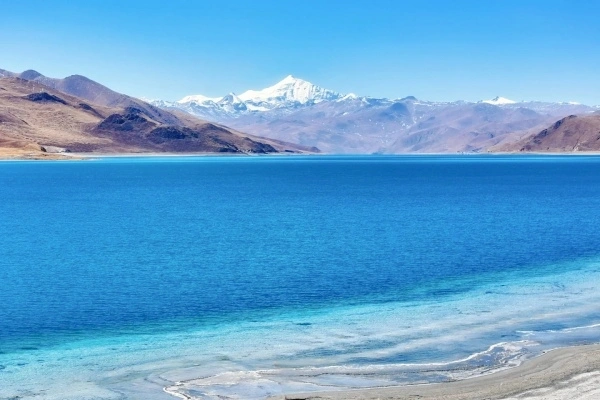
After breakfast, head to Yamdrok Lake, located in Gongga County, Shannan Region, Tibet, at an altitude of 3,598 meters, about 10 kilometers west of the county seat.
In Tibetan, the name means “Jade of the Upper Pastures,” and it is often referred to as “Yam Lake.” Yamdrok is the largest inland lake group in southern Tibet, covering an
area of 638 square kilometers. The lake is also believed to be a turquoise earring that a goddess dropped on Earth. From the summit of Gangbala Mountain, at 4,950 meters
above sea level, looking south, Yamdrok Lake resembles a sapphire set among the surrounding peaks. The lake’s smooth, mirror-like surface reflects the brilliant blue sky,
and the view is occasionally interrupted by waterfowl skimming across the water, creating a harmonious contrast with the distant mountains.
Next, visit Karola Glacier, which is the closest glacier to the road in Tibet, with the highway passing only about 300 meters away. Located at the border between Langkazi
County and Jiangzi County, the glacier is 71 kilometers from Jiangzi County. The main peak of the Rakun Kangri Mountain, the highest point in the Gangri Range, is to the
north of the Himalayas. It is said to be the dwelling place of one of Tibet’s Four Great Mountain Gods, the Western Mountain God Nuoji Kangwa Sambu, according to
Tibetan Buddhist legends.
Then, visit Bai Ju Monastery. Bai Ju Monastery, known as “Ban Kuo Qu De” in Tibetan, meaning “The Temple of the Auspicious Wheel and Great Happiness,” is located in
Jiangzi Town, Jiangzi County, Shigatse, Tibet. The monastery is surrounded by mountains on three sides, with water on all four sides. It is about 230 kilometers south of
Lhasa and around 100 kilometers east of Shigatse, at an altitude of 3,900 meters. The monastery is a prominent site for Tibetan Buddhist traditions, housing the Sakya,
Shalu, and Gelug schools.
In the evening, arrive in Shigatse and check in to your hotel.
Day 6: Shigatse - Mount Everest
Shigatse – Tashi Lhunpo Monastery – Dingri – Mount Everest
4+stars Hotel
Breakfast – Lunch – Dinner
After breakfast, drive to Tashi Lhunpo Monastery, meaning “Auspicious Mount Meru Monastery.” Its full name is “Tashilhunpo Baijide Qinqu Tangjie Le Nanba Jiewa Lin,”
which translates to “Auspicious Mount Meru, Gathering of Blessings and Supreme in All Directions.” Located at the foot of Mount Nisarri, south of Shigatse, Tibet, its Tibetan
name means “Auspicious Mount Meru.” The monastery was founded in 1447 during the Ming Dynasty (the 12th year of the Zhengtong reign).
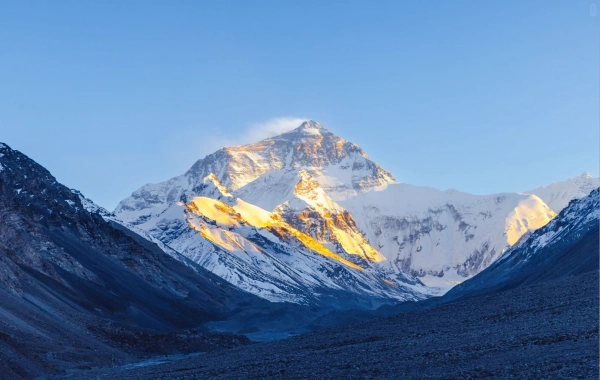
After passing through Dingri, you will arrive at Everest Base Camp in the afternoon to admire the majestic presence of Mount Everest (weather permitting).
Day 7: Everest Base Camp - Shigatse
Everest Base Camp – Gyawla Pass – Shigatse
4+stars Hotel
Breakfast – Lunch – Dinner
Everest Base Camp is one of the best spots for viewing and photographing Mount Everest. Here, there are tents available for climbers and tourists, as well as guesthouses,
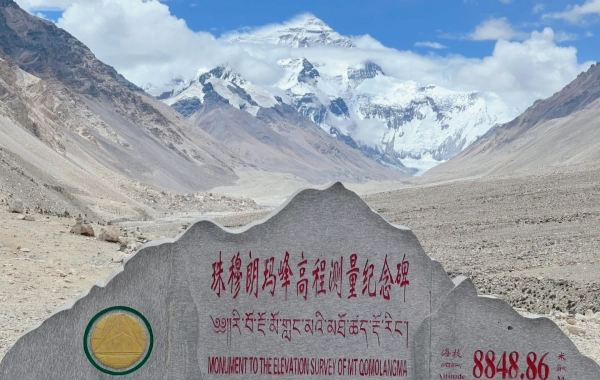
teahouses, shops, and even a post office. Solar panels are installed in front of the tents to provide lighting at night. The base camp also features the “Everest Elevation
Monument,” which includes two markers: one commemorating the elevation of 8,844.43 meters and another marking 8,848.86 meters. Additionally, there is a monument
at 5,200 meters above sea level.
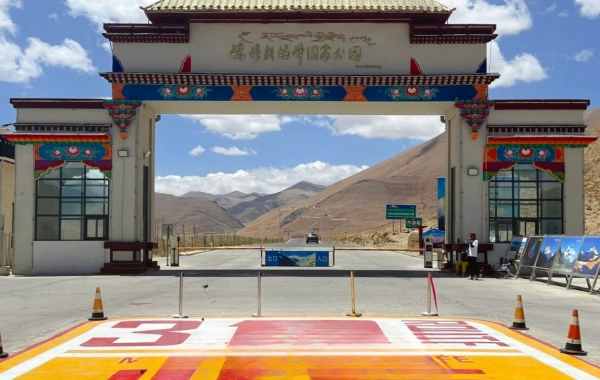
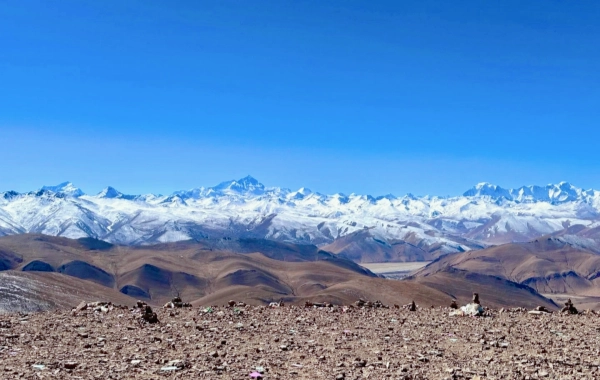
Gyawla Pass is a mountain pass you must pass through to reach Everest Base Camp after entering the Everest National Nature Reserve. The pass sits at an elevation of
5,210 meters. From this point, you can view five snow-capped peaks above 8,000 meters. These are (from left to right): Makalu, Lhotse, Mount Everest, Cho Oyu, and
Shishapangma.
In the evening, arrive in [Shigatse] and check into your hotel.
Day 8: Shigatse - Lhasa
Shigatse – Sera Monastery – Norbulingka – Lhasa
4+stars Hotel
Breakfast – Lunch – Dinner
Return to Lhasa and, on the way, visit Sera Monastery, formally known as “Sera Dajing Monastery.” It is one of the six major Gelug monasteries of Tibetan Buddhism.
Along with Drepung Monastery and Ganden Monastery, it forms the “Three Great Monasteries” of Lhasa, with Sera being the last of the three to be built. Sera Monastery
is a national key cultural heritage site, located 3 kilometers north of Lhasa, at the foot of Mount Sera. It has long been a place for high lamas and living Buddhas to give
teachings, surrounded by many smaller monasteries. To the east and south of the main monastery, you can find Pubu Jue Monastery, Miqiong Reniku Monastery, Gongbasa
Monastery, Pabengang Monastery, Zhaixiqulin Monastery, Qusang Monastery, and Gali Nunnery. Behind the monastery, there are also Zhukang Riqu and Sera Quding
Monasteries, among others.
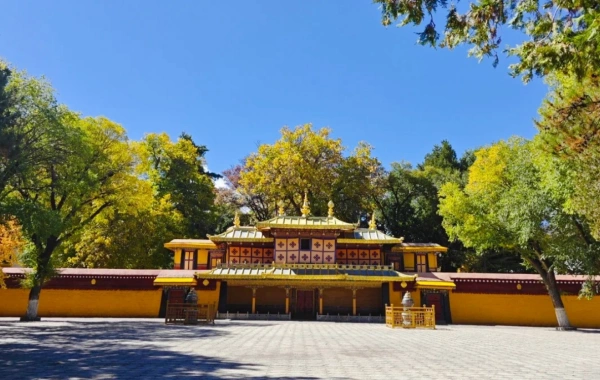
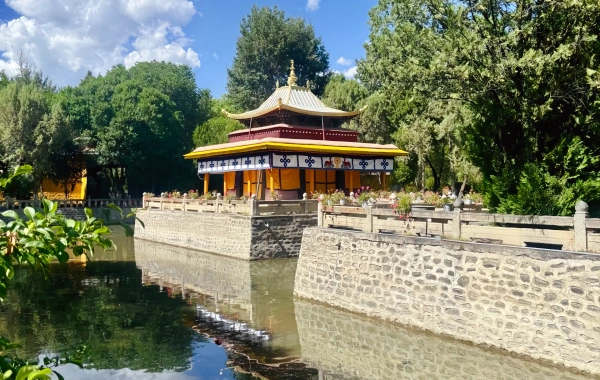
Next, visit Norbulingka, a national key cultural heritage site located on the western outskirts of Lhasa. Built in the 1740s during the reign of the Seventh Dalai Lama, it
served as the summer residence and administrative center for successive Dalai Lamas. The Norbulingka is a classic example of Tibetan garden-style architecture. The area
was originally a shrubland and located along the ancient course of the Lhasa River. The river bends here, flowing gently, and in summer, the grassy embankments and willow
trees reflect in the water, creating a picturesque scene. The Seventh Dalai Lama, Geylang Gyatso, often spent his summers here after studying scriptures at Drepung
Monastery. Due to his fondness for the place, the Qing Dynasty’s Tibetan official ordered the construction of tents near the springs for the Dalai Lama’s rest and prayers,
which marks the beginning of Norbulingka.
In the evening, check into your hotel.
Day 9: Lhasa
Potala Palace – Jokhang Temple – Barkhor Street
4+stars Hotel
Breakfast – Lunch – Dinner
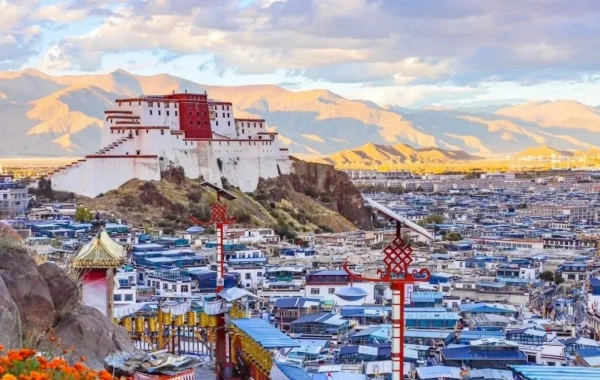
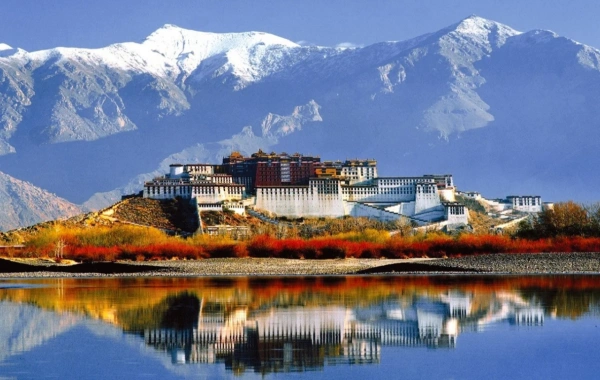
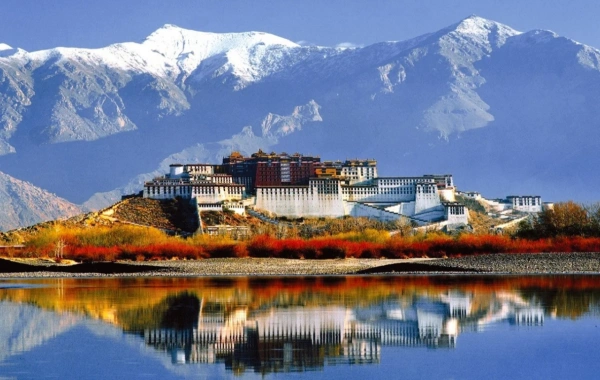
After breakfast, depart for Potala Palace (the visit time will be based on our tour group’s scheduled ticket time; please follow the guide’s instructions). The Potala Palace is
the highest ancient palace complex in the world, standing at an altitude of 3,700 meters. It was originally built in the 7th century, consists of 13 stories, and reaches a height
of about 119 meters. Since the 5th Dalai Lama, it has been the political and religious center of Tibet. The palace is divided into two main parts: the White Palace
(the residence of the Dalai Lamas) and the Red Palace (housing the Dalai Lamas’ tombs and various Buddhist temples). The Potala Palace is home to the golden tomb of the
Dalai Lama, as well as numerous precious murals and thangkas, representing the essence of Tibetan culture. After the visit, walk down the mountain and return to the base
of the palace. On the way down, pass through the Zongjiao Lukang Park, where you can experience the local Tibetan life. The Dragon King Pond, Potala Palace Square, the
Tibet Peace Liberation Monument, the White Stupa, and the Yao Wang Mountain Viewing Platform, which offers the best angle for photographing the Potala Palace
(featured on the back of the 50 RMB note), are all great spots for capturing the palace. Especially on the middle slopes, it’s common to see photography enthusiasts
gathering here, waiting for the first light of day to illuminate the Potala Palace.
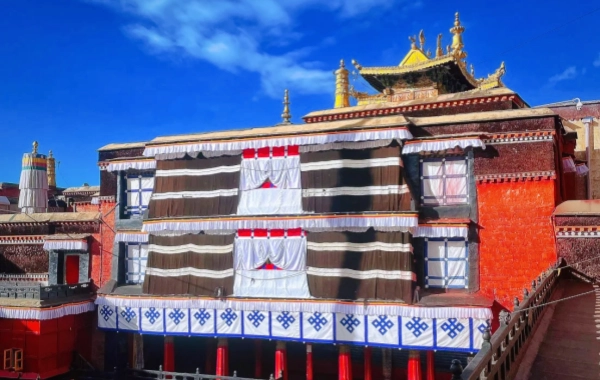
Next, visit Jokhang Temple, which holds the highest status in Tibetan Buddhism. Jokhang Temple is the most magnificent existing building from the Tibetan Empire period
and the earliest wooden structure in Tibet. It also established the pattern of Tibetan-style flatland temple cities. Surrounding the central Shakyamuni Buddha Hall is the
“Nangkor,” while the outer wall of the temple is known as the “Barkhor.” The streets radiating outward from Jokhang Temple are called “Barkhor Street,” also known as the
“Eight Corners Street.” The larger circle, encompassing Potala Palace, Yao Wang Mountain, and the Small Jokhang Temple, is called the “Lingkor.” These three concentric
rings represent the routes used by Tibetans for their pilgrimage prayers.
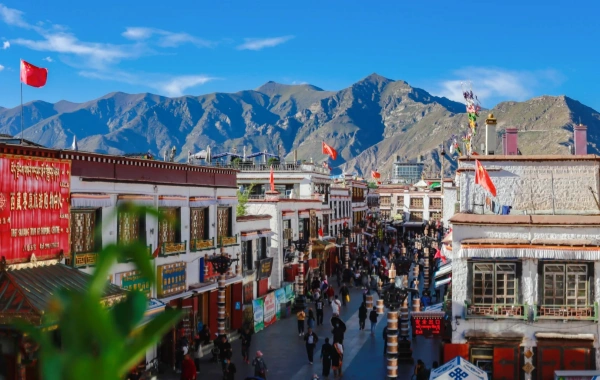
Finally, head to Barkhor Street. In Tibetan, “Barkhor” means “pilgrimage circuit.” Barkhor Street, also known as Eight Corners Street, is located in the Lhasa city center and
is a famous pilgrimage route and commercial hub. It has well-preserved the traditional appearance and living style of the ancient city. Originally, the street was simply a
single route surrounding Jokhang Temple for the pilgrimage prayer, and the Tibetans referred to it as the “Holy Path.”
Day 10: Lhasa
Lhasa – Namtso Lake – Lhasa
4+stars Hotel
Breakfast – Lunch – Dinner
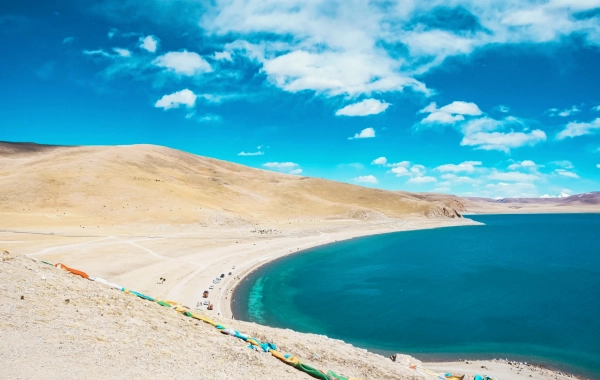
After breakfast, head to Namtso Lake, which is known as “Tenggeri Nor” (or “Tenggeri Lake”) in Mongolian and “Namtso Pumo” in Tibetan, meaning “Lake of Abundant
Heaven” (or “Heavenly Lake,” “Spiritual Lake,” or “Sacred Lake”). Both names refer to “Heavenly Lake.” Namtso is one of the “Three Sacred Lakes of Tibet” and was originally
the first sacred lake of the ancient kingdom of Shannan and the Yungdrung Bon religion, before becoming a famous Buddhist pilgrimage site. Every time a sheep year
(in the Tibetan calendar) arrives, hundreds or even thousands of devotees come to make a pilgrimage. Namtso is also known for predicting good or bad fortune. It is said
that if a person with a strong fate climbs to the hill by the lake, they might witness supernatural phenomena in the water. Because of this, the lake was often a site for
Tibetan Buddhist clairvoyant practices. During the summer, many lamas come to the lake for spiritual pilgrimages and to observe the mystical phenomena that appear in
the water, which are believed to predict the future.
Surrounding mountains appear intermittently through the mist, and as the sun rises, the clouds disperse and a cool breeze sweeps across the land. The vast lake surface
ripples gently, resembling a kind-hearted celestial maiden who waves a white scarf to greet visitors. At this time, the peak of Mount Nyenchen Tanglha becomes particularly
clear, with a pastoral landscape of light green grass, mountains mixed with red and black, and snow-capped peaks. The highest summit stands like a warrior guarding
Namtso. The plateau weather is unpredictable, with strong winds, dark clouds, and snowstorms, but after the storm, the lake’s surface still sparkles with a mesmerizing
shine. Along the way, you can also admire the sacred guardian of Namtso, Mount Nyenchen Tanglha, with an elevation of 7,117 meters. Enjoy the beautiful scenery of the
Northern Tibetan grasslands before returning to Lhasa by car.
Day 11: Lhasa Departure
Lhasa Departure
None
Breakfast
Today, we will make our final pilgrimage in the sacred land of Lhasa. Slowly departing along the Lhasa River Valley, we take one last glance behind, where the Potala Palace gazes longingly at our departing figures. Farewell, my beloved Potala and cherished sunshine of the snow-capped land!